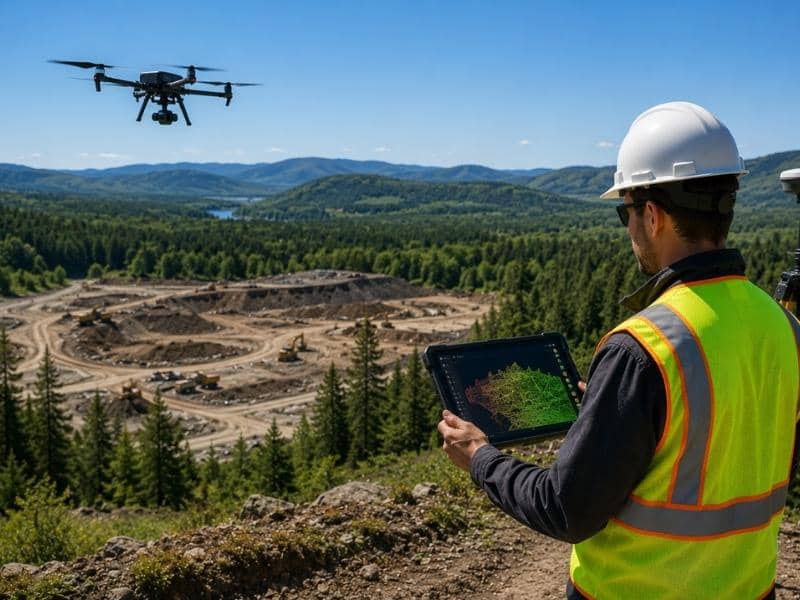
Most land survey projects need more than basic field measurements to get a full picture of the land. LiDAR mapping helps with that. It uses laser beams to collect millions of tiny measurements across a piece of land and build an accurate picture of the ground surface. That level of detail helps engineers, planners, and builders make better choices than older tools allow.
Knowing how LiDAR mapping works helps property owners, engineers, and developers know what to expect when it gets used on their land.
How LiDAR Mapping Captures Detailed Surface Data
LiDAR stands for Light Detection and Ranging. The system shoots laser beams at the ground and measures how long each beam takes to bounce back. That time tells the system how far away the ground is. Do that millions of times across a piece of land and the result is a large collection of precise height points called a point cloud.
What makes this so useful is how much data it collects. A standard ground survey takes measurements at certain spots only. LiDAR collects data across the whole surface, including the spaces in between. That extra coverage shows slope changes, uneven ground, and land features that a standard survey might miss.
LiDAR also stays accurate across large pieces of land. One survey can cover hundreds of acres and stay precise the whole time. That makes it a great fit for projects that need detailed land data before design or building work begins.
Why LiDAR Works Well in Hard-to-Reach Places
Rough land slows down survey crews on the ground. Steep hills, thick bushes, wet areas, and dense woods all make ground measurements harder to do. LiDAR works differently because the data gets collected from above, not from the ground.
One helpful feature in wooded areas is how the laser beams travel. They don’t all stop at the tops of the trees. Some pass through gaps in the branches and hit the ground below. The system records more than one return from each beam: one from the top of the trees, one from the middle branches, and one from the ground. That last return is what surveyors need to build an accurate ground picture, even in areas with thick trees.
This makes LiDAR a smart choice for sites where sending a ground crew would take much longer, collect less data, or put workers in unsafe spots.
Turning Point Clouds into Useful Survey Products
Raw LiDAR data is a point cloud: millions of individual height measurements floating in three-dimensional space. That raw data can’t be used right away. It has to be turned into products that engineers, planners, and designers can actually work with.
The most common products made from LiDAR data include:
- Contour maps that show lines of equal height across the land, used for grading and drainage planning
- Digital elevation models that show the surface as a grid of height values used in design programs
- Digital terrain models that remove trees and buildings to show only the bare ground
The quality of these products depends on how much data the point cloud has and how carefully it gets processed. Removing tree measurements, sorting surface types, and checking data against known fixed points all help make the final products accurate.
Where LiDAR Fits into a Land Survey Project
LiDAR does not replace regular survey methods. It works with them. Using both together gives better results than either method gets on its own.
Regular ground surveys provide the fixed points that LiDAR data connects to. Surveyors place carefully measured control points across the land before any LiDAR data gets collected. Those points give the LiDAR data its correct position on a real map and help the final products meet the accuracy levels needed for engineering and permits.
After LiDAR data is collected and processed, regular field work often continues for tasks that need someone on the ground: placing property corners, checking specific heights, finding buried pipes, or collecting details the LiDAR system can’t pick up from above. The two methods cover different parts of the job, and using both gives a more complete picture of the land.
The Benefits of LiDAR Mapping for High-Precision Projects
The real value of LiDAR shows up most on projects where accuracy, coverage, and speed all matter at the same time.
Key benefits that make LiDAR useful for engineering and building projects include:
- Faster data collection across large or complex sites compared to ground methods
- More data points that show land details and slope changes more completely
- Steady accuracy across large areas without dropping off
- Better results on wooded or rough land where ground access is hard
For engineering and building projects, that level of detail shapes real decisions. Drainage systems get sized using accurate slope data. Grading plans get built from reliable height models. Cut and fill estimates come from land data that shows the real ground rather than guesses between widely spaced measurements.
For property owners and developers, LiDAR mapping means the data behind key decisions reflects what is actually on the ground, not rough estimates.
Frequently Asked Questions
What is LiDAR mapping?
LiDAR mapping is a survey tool that uses laser beams to measure distances and build accurate three-dimensional pictures of the ground. It collects millions of data points to create detailed height information for planning and design.
How does LiDAR mapping improve survey accuracy?
It collects data across the whole site rather than at certain spots only, which shows land details and slope changes that standard field measurements might miss.
Can LiDAR mapping be used in wooded areas?
Yes. LiDAR beams can pass through gaps in the tree tops and bounce back from the ground below, making it useful in areas with thick trees where ground access is hard.
What products can be made from LiDAR data?
LiDAR data gets turned into contour maps, digital elevation models, digital terrain models, and other products used for engineering design, drainage planning, and site work.
Why is LiDAR mapping important for high-precision land surveys?
It provides fast, detailed land data across large and complex sites, which helps engineers make accurate decisions and lowers the risk of errors from incomplete surface information.
